Tag Archive for 'RAID'

RAID1 replace broken HDD

If you see something like this on your monitor or in your logs, you should worry about your important data.

And immediately change your HDD!

1
2
3
4
5
6
7
8
9
10
ata1.00: exception Emask 0x0 SAct 0x0 SErr 0x0 action 0x6 frozen
ata1.00: failed command: FLUSH CACHE EXT
ata1.00: cmd ea/00:00:00:00:00/00:00:00:00:00/a0 tag 0
res 40/00:0c:b9:68:55/00:00:05:00:00/40 Emask 0x4 (timeout)
ata1.00: status: { DRDY }
ata1: hard resetting link
ata1: link is slow to respond, please be patient (ready=0)
ata1: SATA link up 3.0 Gbps (SStatus 123 SControl 300)
ata1.00: configured for UDMA/133
ata1: EH complete

Continue reading ‘RAID1 replace broken HDD’

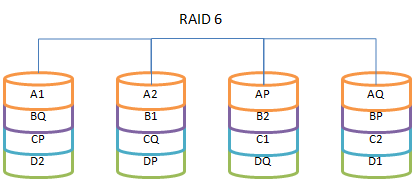
RAID 6

A RAID 6 is another form of parity protection for disks. Called dual parity too.

Requirements: 4 Disks
Capacity: (Size of Smallest Drive) * (Number of Drives – 2)
Read: Very good read performance
Write: Poor write performance due to dual parity overhead and complexity

For this RAID level you should use a hardware controller.

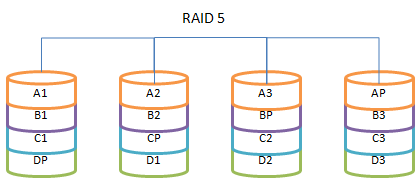
RAID 5

A RAID 5 uses block-level striping with parity data distributed across all member disks.

Requirements: At least 3 drives
Fault Tolerance: (N – 1) Can tolerate loss of one drive
Capacity: (Size of Smallest Drive) * (Number of Drives – 1)

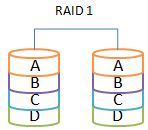
RAID 1

RAID 1 – Mirroring without parity or striping.

- Minimum disks: 2
- Data redundancy (mirror)
- One disk may fail
- Effective protection against physical disk failure

RAID 0

RAID 0 is a simply data stripe over several disks.

- No data protection
- Better performance
- Requirements: At least 2 drives
- Put several disks to one bigger one
- If one disk fails, you lose all your data
- Raid 0 is excellent for non-mission critical situations